
Press releases
iunie 17, 2024 2026-07-21 19:06Press releases
Project closing press release
Digitalization does not enhance the profitability of automotive companies, but it improves asset efficiency
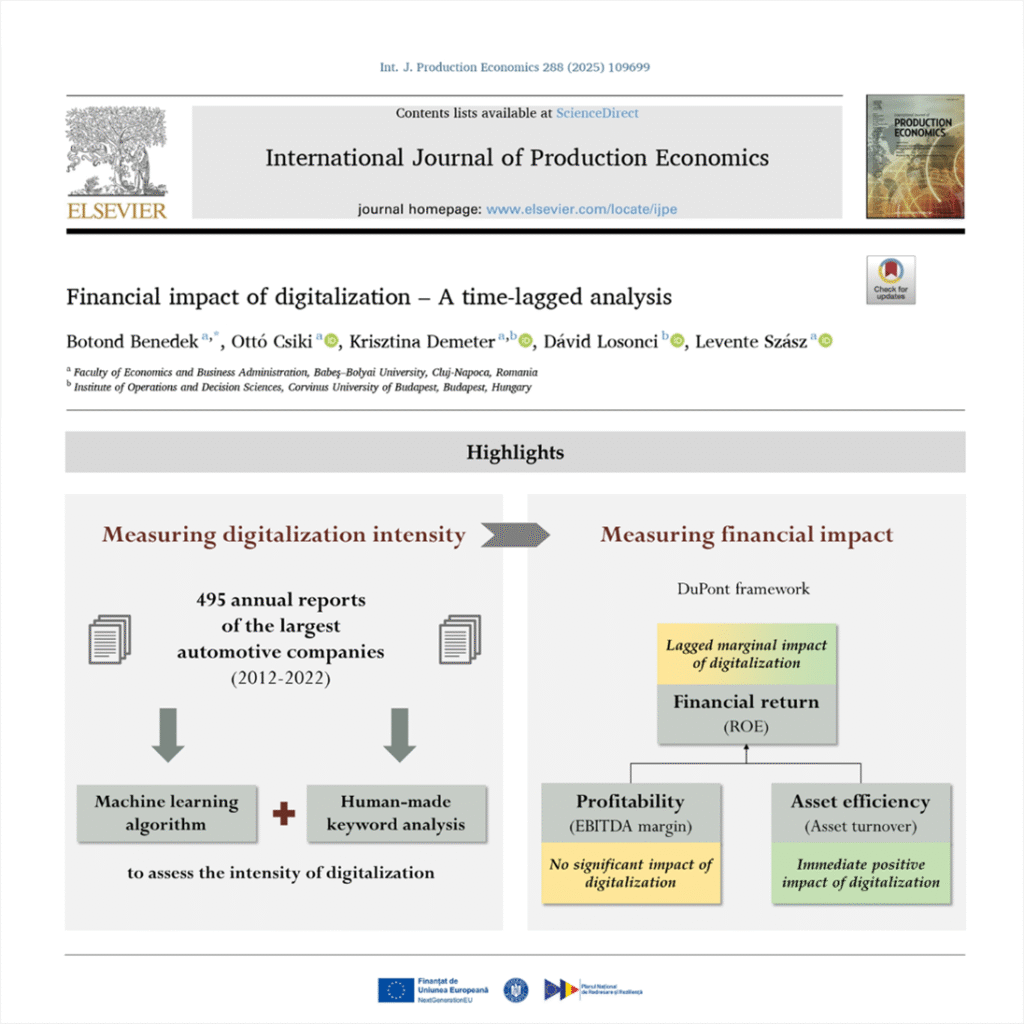
The use of modern digital technologies does not contribute to increasing the profitability of companies in the automotive industry, but it significantly improves asset efficiency, with effects becoming visible almost immediately — shows a study funded by the European Union. The research was conducted by the Faculty of Economics and Business Administration at Babeș-Bolyai University (Romania), in collaboration with researchers from Corvinus University of Budapest (Hungary) and Aalborg University (Denmark). Focusing on the world’s largest automotive manufacturers and suppliers, the study analyzed the financial effects of digitalization across multiple time horizons, including same-year, one-year, and two-year impacts. The results reveal that digital technologies have no measurable effect on profitability even after two years, while the efficiency of asset utilization shows a significant and nearly immediate improvement.
The automotive industry has always been a frontrunner in adopting modern technologies introduced by previous industrial revolutions, and this remains true for the digital technologies of the Fourth Industrial Revolution (Industry 4.0) as well. For this reason, the BBU research focused on automotive companies and examined two categories of digital technologies: on one hand, traditional digital technologies associated with the Third Industrial Revolution (Industry 3.0), which emerged with the advent of electronic computing and manufacturing automation. These include industrial robots, automation systems, telecommunications technologies, and online operations. On the other hand, the study specifically investigated cutting-edge technologies from the Fourth Industrial Revolution (Industry 4.0), including sensors, cloud computing, artificial intelligence, and nanotechnologies.
“The research yielded several surprising results: the intensity of technology usage does not lead to increased profitability either in the short term (same year) or in the medium term (within 1–2 years) – not even when analyzing the world’s most successful automotive companies. In contrast, the efficient use of assets improves both in the short and medium term. Comparing these two findings, the researchers concluded that the return on digital technologies is not straightforward: while the overall financial return on digitalization is positive, it is weak and typically takes at least two years to become noticeable,” summarized Dr. Levente Szász, Vice-Rector of BBU and coordinator of the research project.
About the research methodology
The automotive industry research was carried out within the framework of a €1.4 million EU-funded project led by UBB. The project, titled “Strengthening the digitalization of businesses in Eastern Europe – a micro and macro-level approach” and running from 2023 to 2026, aims to support the adoption of digital technologies in business processes and help overcome implementation challenges, thereby increasing the level of digitalization in the Eastern European corporate sector.
The current study focused on companies among the world’s 30 largest automakers and 100 largest automotive suppliers for which at least 5 annual reports were available from the 2012–2022 period. In total, the research analyzed 495 annual reports from 54 major corporations. The sample included several companies well-known in the region, such as Volkswagen AG, Toyota Motor Corp, Stellantis, and Mercedes-Benz Group. Based on the companies’ annual reports, the researchers used text mining techniques, keyword-based analysis, and a machine learning algorithm to calculate digitalization indexes for both Industry 3.0 and Industry 4.0 technologies. Financial indicators were extracted from the companies’ audited financial statements. Profitability was measured using the EBITDA margin, asset efficiency was measured by asset turnover (revenue/total assets), and return was measured by return on equity (ROE).
The full research is available for free here: https://doi.org/10.1016/j.ijpe.2025.109699
Asian Automotive Industry Outpaces Europe in Digitalization
In the automotive industry, the past decade has witnessed the dynamic expansion of Industry 4.0 technologies, as highlighted by a European Union-supported research project conducted by the Faculty of Economics and Business Administration at Babeș-Bolyai University in Cluj-Napoca. Researchers from institutions such as Corvinus University of Budapest are also contributing to this study. At the same time, the largest automotive companies have not abandoned more traditional (digital) technologies. The fact that Asian companies are overtaking European ones in terms of digitalization is largely attributable to Asian automotive supplier firms.
The automotive industry plays a significant economic and employment role in every region, whether in Europe or East Asia (China, Japan). In Central Europe, it is also evident that the industry is undergoing profound transformations. The shift to electromobility and the challenges surrounding it are further intensifying the already fierce competition among automakers. Remaining competitive requires increased efficiency, which involves renewing manufacturing technologies and processes based on digital production.

The 10-year analysis highlights a steady increase in both traditional and cutting-edge Industry 4.0 technologies in the automotive sector. Traditional technologies, such as robotics, radio-frequency identification (RFID), and algorithms, have grown by 15%, reaching a score of 54 on the researchers’ 0-100 digitalization scale. Meanwhile, advanced Industry 4.0 solutions, including IoT, smart machinery, AI, and simulations, have surged by 24%, reaching a score of 26.
“While Industry 4.0 solutions are advancing dynamically, traditional technologies remain widely used,” explains Krisztina Demeter, Professor at Corvinus University and a member of the research team. “Their prevalence reminds us that Industry 4.0 innovations are built on the established technologies.

The study focused on the largest 30 automakers and the top 100 automotive suppliers by revenue, examining companies with at least five years of reports available from 2012-2022. Among the analyzed firms, 50% were Asian, 41% European, 7% North American, and 2% South American. The largest company in the sample, both in revenue and number of employees, was the Volkswagen Group.
“As the automotive industry copes with challenges like electrification, enhancing efficiency remains critical. Understanding the digital readiness of market players is key in this highly competitive sector”, said Krisztina Demeter.

Digitalization: one word, two realities - what does it really mean for SMEs and multinationals? An artificial intelligence-based analysis of executive interviews
The world of digitalization promises benefits for nearly all types of organizations, including businesses. Therefore, companies aim to digitalize an increasing number of processes. But how does this process differ for local small and medium-sized enterprises (SMEs) compared to large multinational companies? An AI-based topic modelling approach was used to analyze 27 interviews with executives, demonstrating that company size and type can strongly influence how digitalization is approached and implemented. The findings show that local SMEs and large multinational companies approach digitalization very differently. SMEs aim to adopt digital technologies, but limited resources and operational pressures make this journey challenging. Their approach is mainly incremental and problem-focused. In contrast, multinational companies take a broader, more strategic approach. With established systems, skilled teams, and prior experience, they treat digitalization as an organization-wide transformation. Advanced technologies such as AI, robotics, and automation are already being implemented, enabling them to address digital challenges more confidently than SMEs. This contrast highlights a digital divide: while local SMEs are still catching up, large corporations are actively shaping the future of digital business.
Digitalization is on the fast track, but resources are tight
In SMEs, a more focused and operationally-driven pattern of digitalization is visible.ÂDigitalization in SMEs appears to be more incremental and problem-oriented, shaped by limited resources and the need to deliver direct, short-term operational benefits rather than to develop broad and complex digital ecosystems.
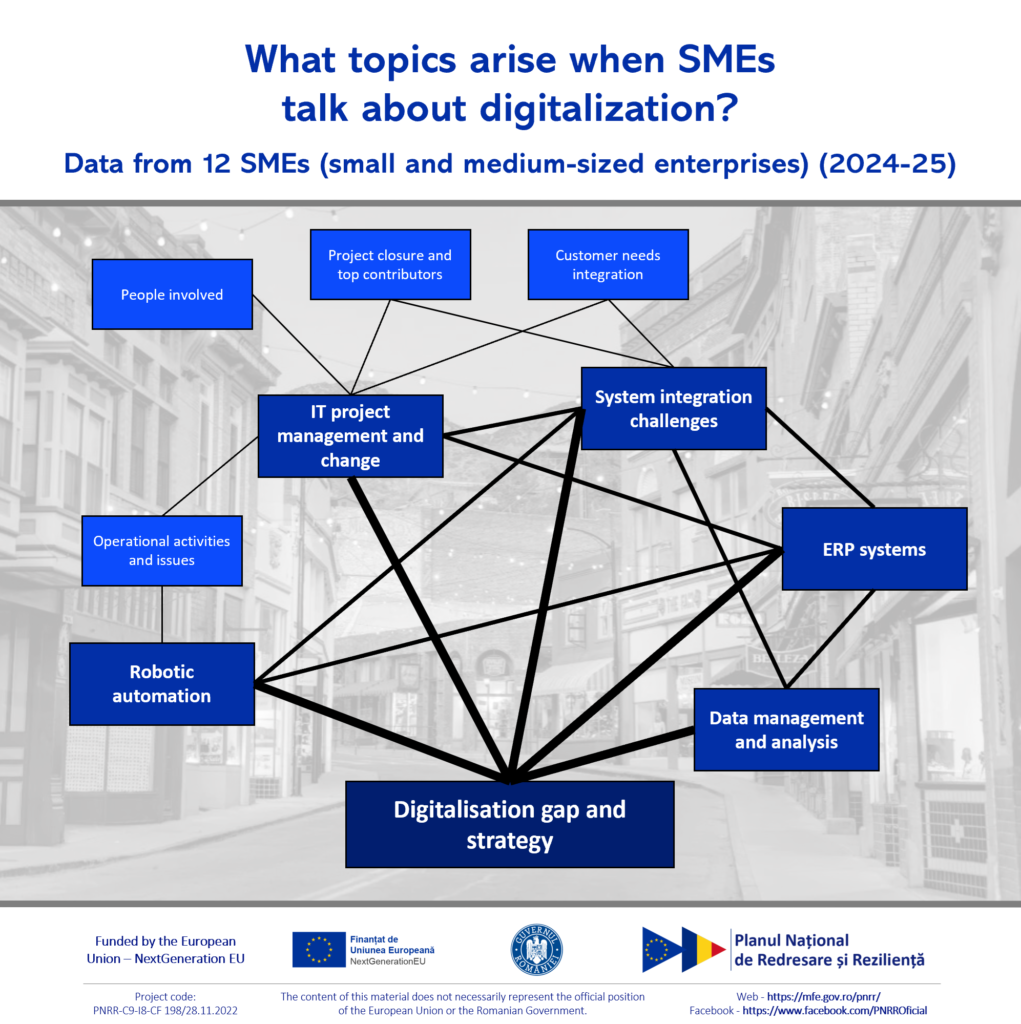
When SMEs talk about digitalization, the dominant theme that emerges is about the “digitalization gap and strategy”, suggesting that SMEs perceive themselves as lagging behind; however, they at least have a strategy to catch up. Executing this strategy can be challenging, as digitalization-related topics (such as Robotic automation, and Data management and analysis) are generally mentioned together with challenges related to IT project management and change, system integration, and ERP systems.
System integration and ERP-related challenges are clearly visible for SMEs and are interconnected with several other challenges, indicating the multitude of barriers SMEs have to overcome. Thus, digitalization is on the horizon for SMEs, but reaching it is difficult. Operational activities and issues (such as time management, inventory, efficiency, sales, and warehousing) are connected to robotic automation and IT project management and change. This indicates that fast results and efficiency gains are the primary drivers of digitalization and are expected outcomes of IT projects and change management initiatives.
SMEs also frequently mention the people involved and customer needs related to digitalization. This indicates that they are human resources remain an important factor in digital transformation and SMEs stay committed to engaging and supporting employees throughout the digitalization journey. At the same time, customer needs are also in focus, remaining an important consideration that needs to be integrated in digitalization projects.
From challenges to solution: multinationals lead the way in digitalization
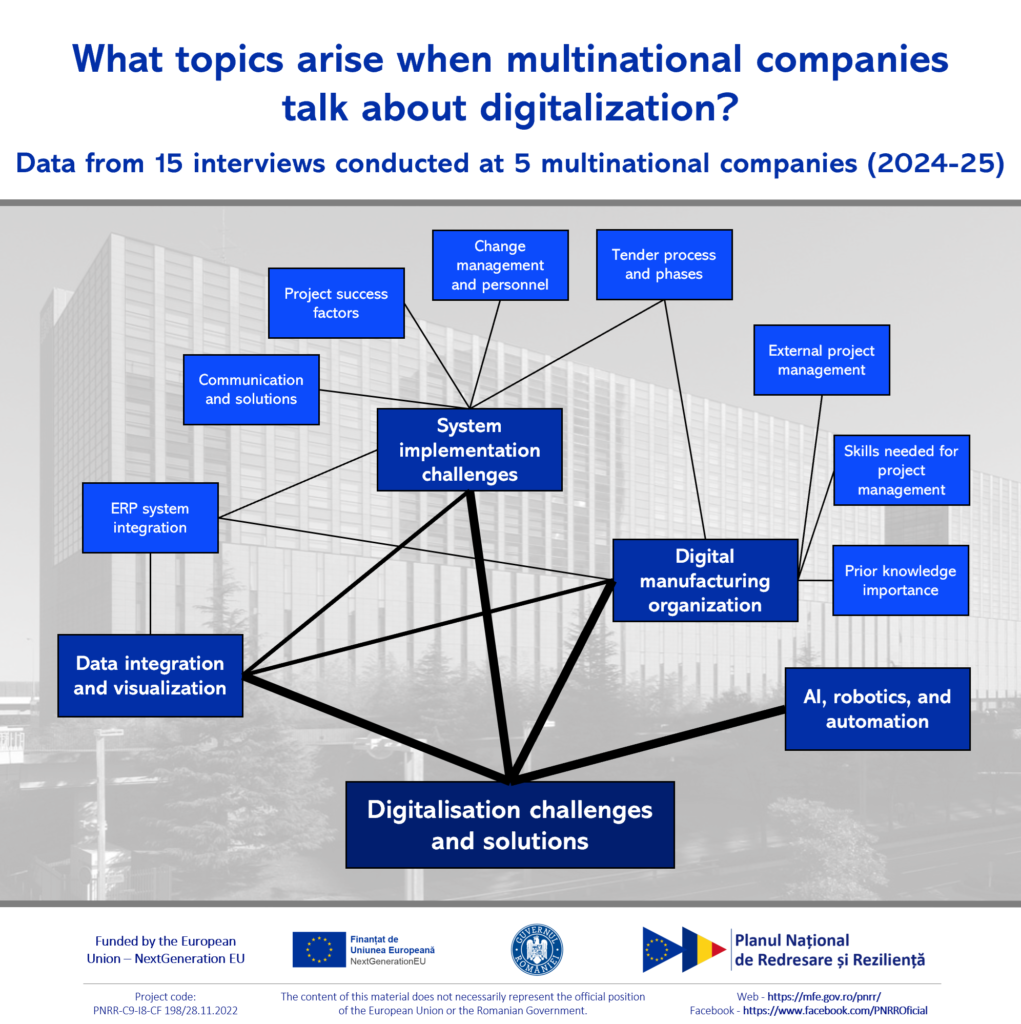
At large multinationals, an interconnected digitalization landscape is observed. Main interconnected topics such as data integration and visualization; system integration; AI, robotics, and automation; and digital manufacturing organization indicates that digitalization in multinational companies is treated as a strategic, organization-wide transformation. When multinational companies talk about digitalization, the dominant theme is related to digitalization challenges and solutions, which is fundamentally different from the perspective of SMEs where mostly challenges are emphasized. While multinationals also face challenges related to digitalization, they appear to be more confident in identifying the appropriate solutions or have already addressed similar issues in previous digitalization projects.
Research methodology
In this research, 15 interviews with company managers at 5 large multinational companies (across different countries)and 12 interviews from local SMEs (located in Romania, Hungary and Denmark) were analyzed. Among the multinational companies, the manufacturing and retail industries were highly represented. In the case of SMEs, the variety of industries was wider, with many different sectors represented (including manufacturing, trade and services as well).
All interviews were semi-structured, following a predefined guideline while allowing space for interviewees to freely express their thoughts and experiences.
Each interview was transcribed, and the transcripts were analyzed using an AI-based topic modeling technique.The model identified relevant topics and calculated their similarity. Only high similarity values(0.60 or higheron a 0.00 – 1.00 scale) were highlighted on the figure, as these may enable meaningful conclusionsabout digitalization in multinational companies and SMEs. The separation by company type was necessary, as large multinational companies and local SMEs operate in significantly different ways.


